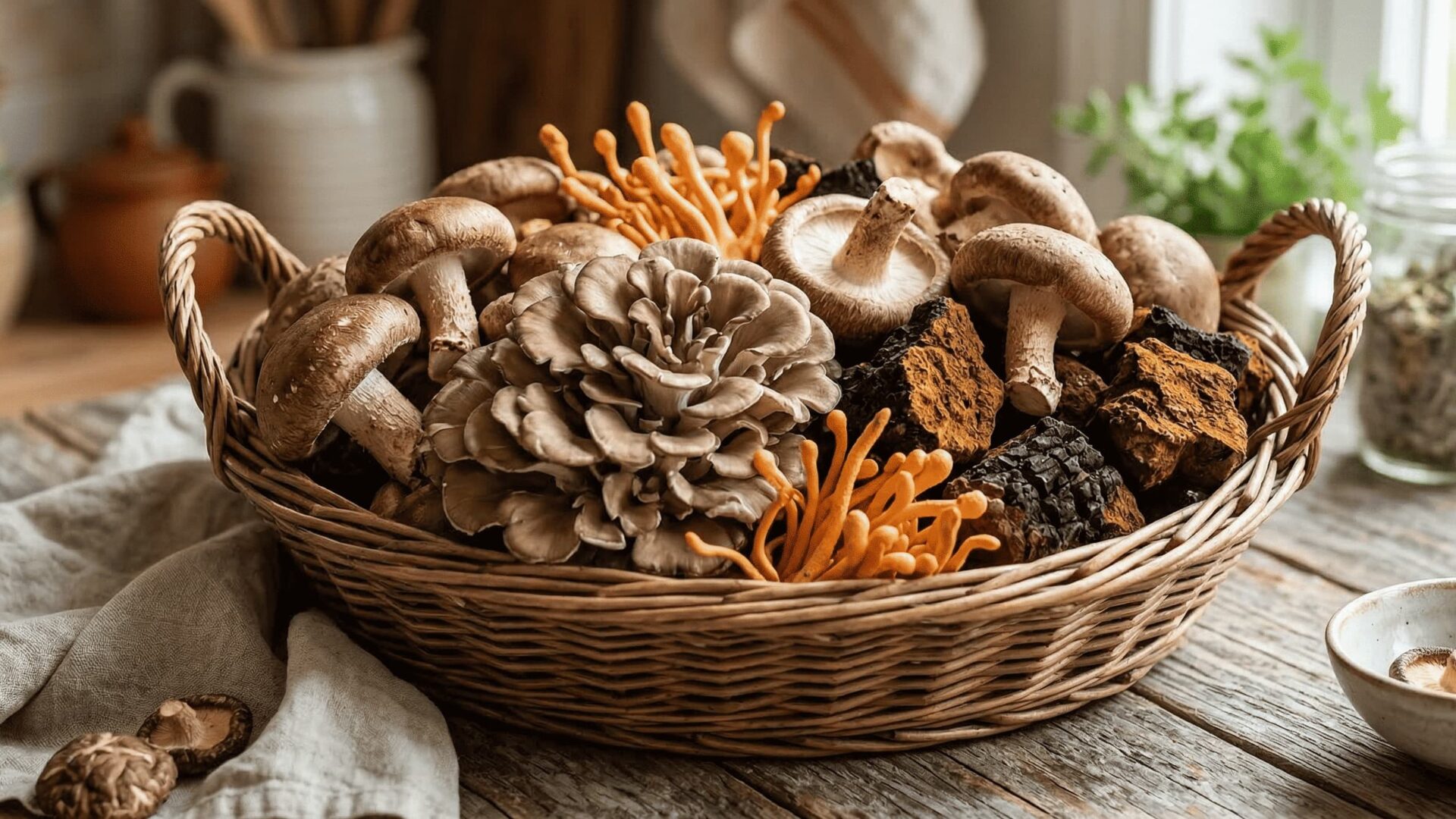
In today’s world, people consume mushrooms globally on a daily basis, and their popularity continues to rise. Mushrooms are nutritionally dense and often used to complement certain dishes and even serve as a vegan substitute for meat. These mushrooms have a wide range of uses, and you might even have one of the many varieties at home right now!
But have you ever wondered what mushrooms really are and what makes them so nutritious? At Midra, we are exploring new ways to maximize the health benefits of medicinal mushrooms for you, the consumer. In this blog, we explain what mushrooms are, their history of consumption, and how Midra strives to unlock their full nutritional potential.
1. What is a mushroom?
A mushroom is the fruiting body of a type of fungus. The fungus itself often lives underground as a network of mycelium, while the mushroom pops up above the surface to release spores. There are several ways to grow mushrooms. For example, inside decaying organic material such as rotting logs, sawdust, or even rice. The mushroom produces spores, which can be compared to seeds.
Looking at mushrooms, these organisms are neither a plant nor animal. They are a separate kingdom altogether. Unlike plants, which have cellulose in their cell walls, fungi have sturdy cell walls made of chitin and beta-glucans. Fungi cannot perform photosynthesis. Instead, they absorb nutrients by breaking down and digesting organic matter around them.
2. Chinese historical use of mushrooms
For thousands of years, practitioners have used mushrooms in Chinese medicine, with historical records dating back to ancient times when they were consumed not only as food but also for their highly valued medicinal qualities. Reishi, for example, has been used for over 2,000 years in Traditional Chinese Medicine and was traditionally associated with royalty, health, recuperation, longevity, sexual prowess, wisdom, and happiness. It was even depicted in royal tapestries alongside renowned sages of the era, and for a time, some believed that a tincture made from this mushroom could bring the dead back to life if laid upon the deceased’s chest.
Similarly, Cordyceps, a parasitic fungus, was a rare and precious remedy reserved for the elite, prized for its unique ability to balance both Yin and Yang. The mushroom was primarily prepared in medicinal broths to strengthen the kidneys and lungs. To this day, this ancient knowledge continues to influence modern practices and supports the use of mushrooms as a natural way to enhance overall well-being.
3. Identifying mushrooms
All mushrooms come in a wide variety of shapes, sizes, colours and textures. A typical mushroom has a stem, a cap, and gills underneath the cap which release spores. Some mushrooms may have a spongy underside instead of gills, while others might look coral-like or fan-shaped.
Common mushroom examples include:
- Agaricus bisporus: small, white, and round.
- Shiitake: wide, umbrella-like brown cap.
- Oyster: fan-shaped and soft.
- Lion’s Mane: fluffy, white, and resembling a pom-pom.
Each species has its own unique structure and characteristics, many of which contribute to their taste and nutritional profile.
4. Nutritious mushrooms
Currently, there are more than 10,000 known species of mushrooms, although many mycologists suggest that the actual number could be far higher, possibly over a million species with many still undiscovered or unclassified.
Among the known varieties, several are renowned for their nutritional and medicinal properties, including approximately 2,000 edible species. Here is a list of some popular mushrooms:
- Reishi (Ganoderma lucidum)
- Cordyceps sinensis
- Chaga (Inonotus obliquus)
- Turkey Tail (Trametes versicolor)
Structurally, mushrooms consist of about 90% water. Yet, they are packed with nutrients such as vitamins, selenium, potassium, fibre, and antioxidants, to name a few. Of the dry material content, about 30% to 60% consists of beta-glucans, depending on the mushroom species. Beta-glucans are a type of polysaccharide naturally occurring in the cell walls of mushrooms and are associated with several health benefits.
Meanwhile, other components such as polyphenols and triterpenes make up 0.1% to 0.5% of the total dry weight. Consequently, to unlock the full nutritional capabilities of these compounds for the consumer, it is important to find a way to extract them from the cell walls without losing the nutritional benefits. This is what Midra specializes in.
5. Unlocking the full nutritional values inside mushrooms
At Midra, we believe in unlocking the full nutritional benefits of mushrooms. To achieve this, we need to stay in close contact with our suppliers to ensure we receive the best quality mushrooms. Maintaining strong relationships with our partners is key, and as a result, we will perform additional testing whenever necessary. Furthermore, the mushrooms we buy are of organic grade, which means that there are no pesticides involved in the growth of the mushrooms.
Once received, each batch undergoes internal inspection and testing. Next, we extract the nutrients in a way that breaks down the thick chitin and beta-glucan cell walls. This is essential to release their valuable nutrients, such as beta-glucan from their cells and cell walls, along with other active compounds without degrading their potency. Ultimately, this provides our consumers with the best value for the ingredients they buy.
6. Liposomal mushrooms
Up until now, we’ve discussed how we extract nutrients from mushrooms for maximum benefit. However, at Midra, we go a step further. We integrate our mushroom extracts into liposomes: tiny, lipid (fat-based) vesicles that encapsulate the nutrients. This technology increases bioavailability in the body. By using liposomal delivery, we ensure that your body receives more of the beneficial compounds in each serving compared to traditional methods of supplementation. After all, when taking mushroom capsules, the goal is to absorb the maximum amount of these active compounds. That is precisely why, at Midra, we incorporate liposomes into our products. There is a wide variety of mushrooms that we’ve integrated with liposomes here at Midra, including Reishi, Lion’s Mane, and Chaga, to name a few.
7. Conclusion
To conclude this blog, we hope you gained greater insight into mushrooms as a species and how we at Midra try to unlock their full potential as a supplementary product.
Interested in liposomal mushroom products?
Or request our product catalogue via the form below.
Request full product catalogue
Interested in our line-up? Fill in your details below and we’ll send over our full product catalogue.