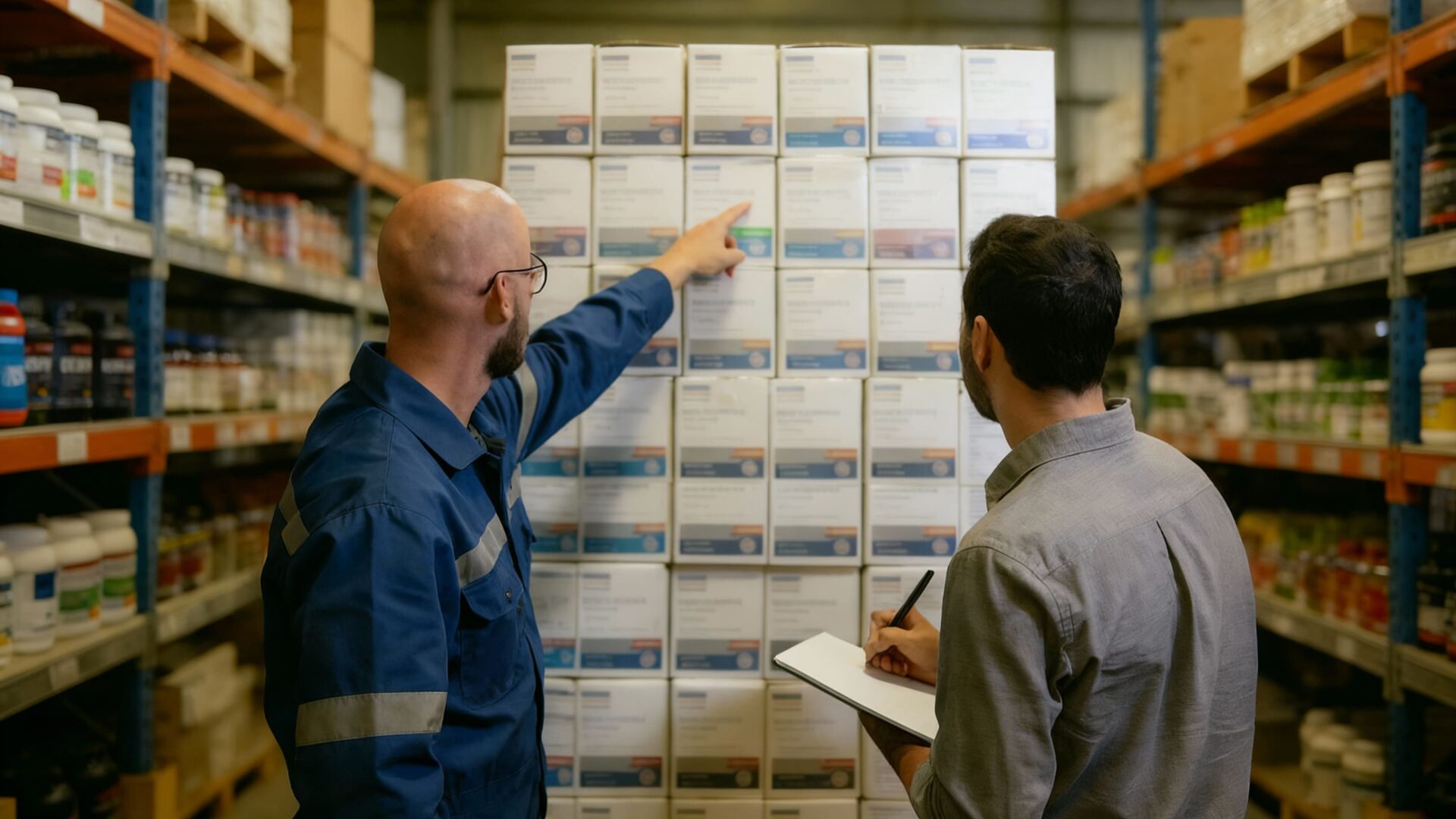
The supplement industry has an overabundant number of suppliers to choose from, but how can you be sure your chosen supplements are truly what they claim to be? At Midra, we understand that product quality is essential to gaining your trust. You might wonder, “what is product quality to you, and how do you maintain it?” The immediate answer is “because we manufacture the best products!” However, for us, product quality goes beyond the final capsule. It’s about ensuring safety, consistency, and knowing exactly what you’re putting into your body.
This blog post gives you an in-depth look at Midra’s comprehensive product quality assurance process.
Our approach to product quality
At Midra, we believe the product quality hinges on every single step in the supply chain, from initial purchasing to final distribution. It’s a continuous chain where each link is of critical importance. Our quality framework consists of:
- Understanding what we manufacture: Defining the product’s purpose and achievable standards.
- Purchasing and testing raw materials: Ensuring the ingredients meet our demands.
- Mastering the manufacturing process: Applying expertise and precision to every batch and recipe.
- Optimizing production scale and storage: Adapting to order sizes and maintaining ideal conditions.
- Protecting the end product through packaging and storage: Ensuring integrity from our facility to your door.
- Sampling and testing: Verifying product quality and enabling traceability.
- Continuous evaluation and improvement: Learning from every experience and keeping improving.
By controlling these steps, we ensure a high level of consistency in every batch produced. Let’s dive deeper into each one.
1. Understanding what we manufacture
The first pillar of our product quality framework is arguably one of the most critical ones. It sets the standard for your end products. Our mission at Midra is to provide the highest quality products we can realize. To achieve this, we first require a deep understanding of customer demands and whether they’re achievable or not. While many products are already developed in-house, we also welcome requests for tailor-made formulations. Using our in-house R&D capabilities, we evaluate whether the customer’s formulation requests are practically achievable and safe for consumer usage. Transparency is key here. By clearly communicating any limitations before production begins, we ensure both parties are aligned on the expectations and formulation capabilities.
2. Purchasing and testing raw materials
High-quality products rely on high-quality raw materials. This is why the second pillar is about building strong, trusting relationships with our suppliers that meet strict criteria. They must:
- Provide a Certificate of Analysis (COA) for each batch sent.
- Operate under a relevant and recognized quality system (e.g., ISO 22000, FSCC 22000, ISO 17025). We do make exceptions for companies with a proven, consistent track record of supplying excellent quality products that consistently meet our standards, even if they don’t hold these specific certifications.
- Have a consistent track record of delivering materials that match our specifications.
Most of our trusted suppliers are located within the European Union. When they meet all the criteria mentioned above, additional post-purchase testing isn’t always required by European regulations. However, we will always test when there are any doubts.
For suppliers outside the EU, such as China, we implement even stricter controls. While products from these regions can meet our quality standards on paper, we still perform our own verification, to ensure the quality matches what we demand. After multiple batches consistently meet our quality standards, we grant these suppliers the same trusted status as EU-based suppliers.
3. Mastering the manufacturing process
Once the raw materials meet our product quality standards, our focus shifts to manufacturing. This is where expertise becomes essential.
All production takes place in ISO 22000 certified environments. With decades of experience and knowledge, we understand how important the precise steps and environmental conditions are to achieving the right capabilities and structure of our products. Even minor adjustments in the process can significantly impact the product quality.
For example:
- Powders that are “too fluffy” can lead to lower density, resulting in less powder entering capsules.
- Powders that are too dense affect digestion time.
As you can see, slight variations matter immensely
4. Optimizing production scale and storage
Manufacturing a small batch is very different from larger ones. Every batch requires different approaches, equipment, and environments. For instance, mixing a 20-liter bucket of Vitamin C might be easy and can be carried by one person, but an order 10x larger demands different tools and precautions. Otherwise, it risks compromising the product’s quality and the safety of personnel.
Improper mixing in large batches may lead to an incorrect distribution of ingredients, rendering an entire batch unusable. To ensure the required product quality, we carefully select the right equipment best suited to the order size.
After manufacturing, it is vital to maintain proper storage conditions to ensure that product quality is preserved over longer periods. Even perfectly manufactured supplements can be undone by improper storage, leading to faster product degradation. For example, not storing Vitamin C in a cool environment can lead to rapid oxidation.
5. Protecting the end product through packaging and storage
Proper storage of developed capsules or liquids is crucial for preventing rapid deterioration of the product’s quality. We carefully select containers based on the product’s requirements. Examples are:
- UV-sensitive products receive UV-sensitive pots for storage.
- Oily or greasy liquids get snap-on caps to prevent leakage caused by greasy residue around the caps.
- Capsule bottles receive silica gel packets, which absorb any moisture that may enter.
We also thoroughly check if the labelling on the bottles is clear and corresponds with the manufactured products.
For transportation, we pay close attention to packaging to avoid any damage. Glass products receive protected sides when packed next to other glass bottles to prevent scratches. We also determine how many boxes can be safely stacked without crushing the bottom layers.
These seemingly small but important details ensure that the finished product arrives safely and remains as appealing as intended. They are often the first things customers notice upon receiving their orders.
6. Sampling and testing
Every production batch is sampled for potential future testing. This system is critical for traceability and allows us to analyse potential causes for issues made during manufacturing, storage, or on the customer’s side. By batch sampling, we can better understand where errors may occur, allowing us to better learn from them. This is something Midra takes seriously, since it leads to better consistency, better products, and stronger customer relationships.
7. Continuous evaluation and improvement
No company is perfect, but what sets Midra apart is our commitment to constant improvement. Mistakes can and will happen, but our attitude is to quickly address them, learn from them and make necessary adjustments to prevent recurrence.
Why Midra quality standards set us apart
After having read this blog, we hope you gained a greater understanding of our principles and modus operandi. We adhere to strict core manufacturing values to ensure high product quality but also to continuously improve ourselves.
Quality never stops; it’s a never-ending journey.
Interested in our products? Request our product catalogue via the form below.

Request full product catalogue
Interested in our line-up? Fill in your details below and we’ll send over our full product catalogue.